Here’s your new free desktop calendar. Click the link below the picture to go to a site that you can right click and download the image. This picture was taken at sunrise from the recent trip to Ocean City, Maryland. Have a great September and a fabulous Labor Day Weekend!
The Art of the Sunrise Part Two
Last week I wrote about the difficulty of capturing the enormous dynamic range of a sunrise. In case you missed it click here. At the end of the article I mentioned another way to recreate this daily celestial event through photography, H.D.R. or High Dynamic Range photography. If you’re going to process images through a program that uses this technology, you have to do a little planning before you take the picture with your camera. The key to the whole process is that multiple pictures are taken of the same scene at different exposure settings. The darkest image needs to be dark enough so that the brightest part of the picture is not pure white. When a sunrise is the focus of the picture this spot is normally the Sun. The brightest image needs to be light enough so that the darkest part of the picture is not pure black. This is so that during post processing there is color information throughout the picture. Effectively the dynamic range of the picture is compressed to accurately reproduce what the eye perceived but the camera was incapable of recording. This photograph was processed using Nik (Google’s) HDX Efex Pro 2. I took nine images. Here are the darkest and lightest:
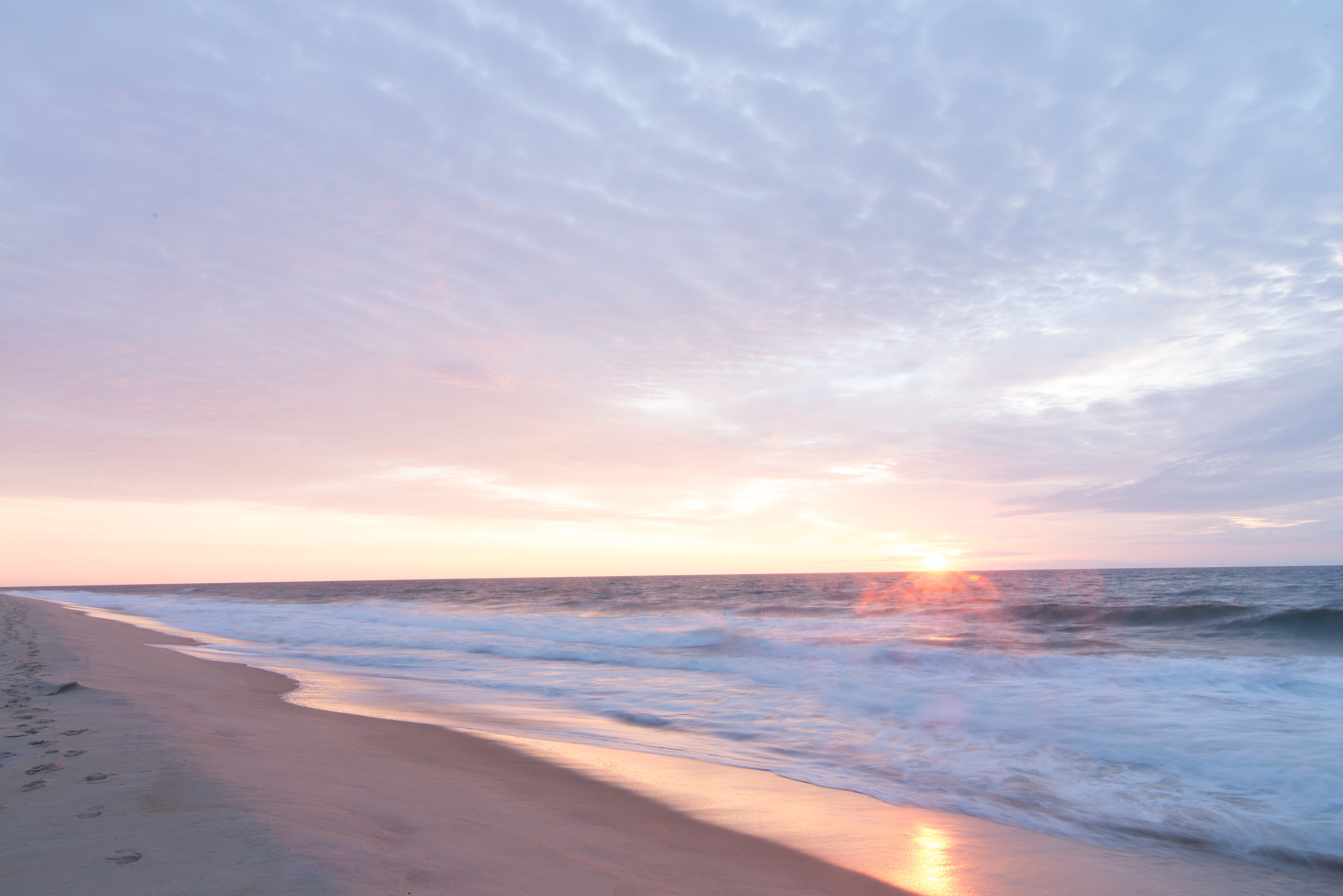
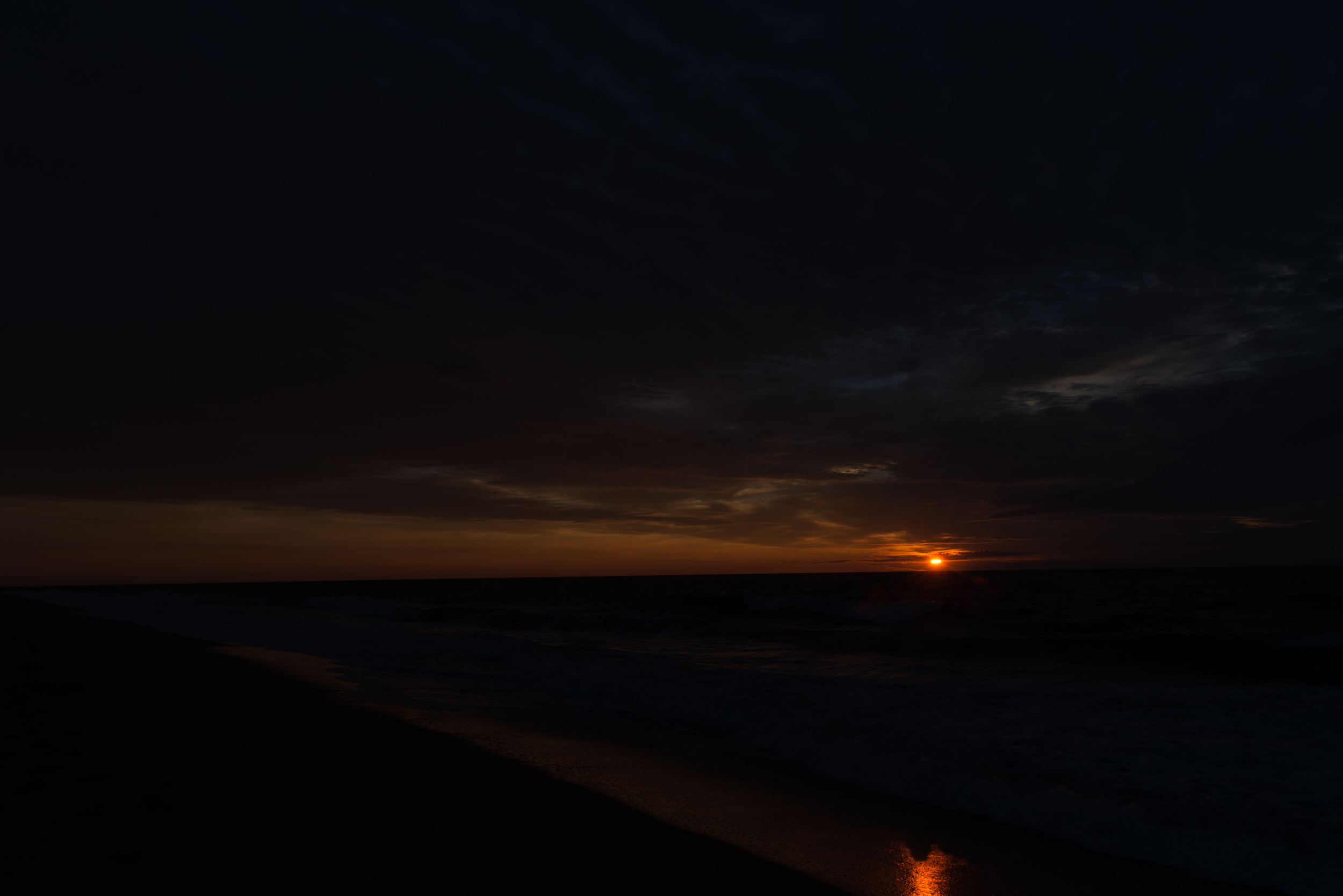
After the magic of the HDR program we have this:

And here’s the finished image after a few touch ups in Photoshop.
#TravelTuesday Delaware County Veterans Memorial
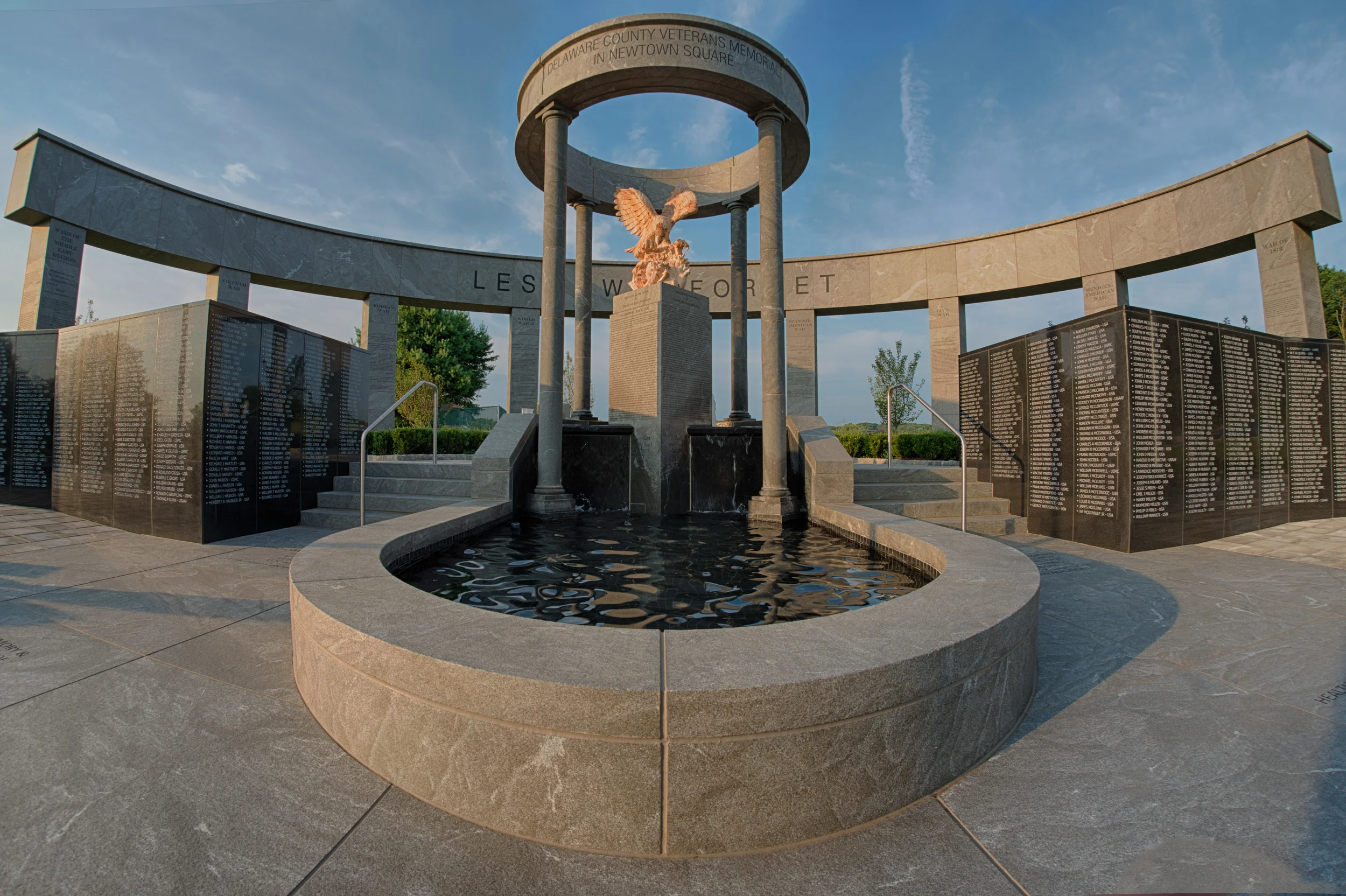
In Newtown Square, Pennsylvania for the last few months I have driven by the construction zone of a memorial that has recently been completed. This beautiful structure is filled with symbolism. There are nine pillars representing each of the wars or conflicts the United States has endured through our history. Each column has quotes from the leaders, generals, and veterans who were serving at the time. The alabaster eagle in the center is a symbol of freedom and strength, placed there to remind us that we are free people. I urge you to take the time and visit this tranquil memorial and reflect upon our nation’s greatness, the price paid to keep us safe, and the honor of the soldiers who gave their lives for our country’s virtues. Please read about the memorial on the website before you go. Your experience will be even more fulfilling. Click the link here: Delaware County Veterans Memorial



XFE Cage War Photography
I was asked to photograph the XFE Cage War #26 at Harrah’s Casino in Chester, PA that took place last Saturday evening. I had been apprehensive about the assignment for a few weeks. I don’t watch events where people beat each other up on television. I don’t particularly like the sight of blood or pain, and I have no idea why anyone would want to harm another human being.
I learned a lot Saturday night.
I learned that there’s much more to cage fighting than violence and giant amounts of testosterone. I saw young men overcome fear, practice a discipline, hone skills, develop their art form, be good sportsmen, and call upon inner strength. For people who used to think like I did before I saw it, MMA or Mixed Martial Arts fighting is profoundly deeper than what it is glorified as on television. Just like NASCAR is more than driving in circles, like playing the piano is more than pushing the correct keys, like writing a novel is more than putting words on a piece of paper, cage fighting is much more than two people beating the crap out of each other.
I had to watch closely what was happening at all times. I was there to capture it and share it with the world that wasn’t there. I was stationed on the floor about 3 feet below the elevated cage. I leaned across an eighteen inch wide catwalk that encircled the entire ring. My lenses were often pressed against the cage and I shot through the holes when I could. Athletes crashed and pounded into the iron inches from my face as I clicked away. I could feel the heat from their bodies, hear their gasps and grunts, smell their fear and see their determination.
They say a picture is worth a thousand words, and I hope mine bring you a closer, more intimate look at these pugilistic warriors. I never turned away while I photographed the fights because I could see the emotions that flooded out of these competitors with every move.
Long live the fighters!
My pictures from the event are on the Independence Sports Magazine website: XFE Cage War #26
The Art of the Capturing a Sunrise Part One
Many mornings we are greeted with a wonderful light show as the Sun sprays its light across the ever spinning Earth. The infinite variety of variables assures each day of its individuality. The position of the Sun, the season, the atmospheric content, water vapor, clouds, etc. wow us with a universal symbol of rebirth each dawn. Creating a good photograph of this celestial event can be challenging.
Watching a sunrise evokes different emotions within each of us, conveying them from the moment they occurred to a canvas that can raise them from your memory in the future is the greatest part of the challenge.
A little biology about our ocular sense; our eyes can see a great amount of contrast between light and dark. In photography the amount of light is measured in f-stops. The human eye can see about twenty f-stops of light, which means if you can picture the blackest black in a dark room, and compare it to a brightly lit glowing white object on a sunny day, this is the complete contrast scale that we can perceive. Divide that into 20 sections of brightness levels and you have our f-stop range of seeable light. Here’s the photography problem: modern cameras can capture between five and six stops of light. Often, this isn’t a problem. Think about a cloudy day. The difference between bright objects and dark objects isn’t that great so a camera’s job is pretty easy. But something like a sunrise, which has a very bright glowing ball of fire in the scene and other objects which have very little illumination because their backs are towards the Sun and are very dark makes a photographer’s job more difficult.
One way of dealing with this huge contrast problem is to rely on the awesomeness of your camera’s sensor and adjust the photograph is using an editing program such as Adobe Lightroom or Photoshop. One advantage of this method is that I can freeze objects in motion with a fast shutter speed. A few of the drawbacks are that the aperture (opening of the lens) must be very wide to capture as much light as possible very quickly which limits the depth of field (think depth of focus) of the image. This is acceptable usually with a sunrise because the clouds in the distance don’t need to be crisp and sharp, after all, they are clouds. Another drawback is that to capture an image at a fast shutter speed the ISO or sensitivity of the camera’s sensor needs to be increased, which increases the amount of noise in the picture. With these limitations, post production becomes very important in photography.
In the photograph below I wanted to show the Sun rising over the ocean with the light being dappled along the crisp spray and the tops of the incoming surf. Shutter speed was 1/1000 of a second to freeze the motion of the spray. Aperture was at f/5.6 to let in a lot of light but to keep the whole wave in focus. ISO was set to 800 so the camera sensor could soak up the light quickly.
Next time we’ll take a look at another way to create a special sunrise picture, High Dynamic Range photography.