Nikon D800 Sigma 24-70mm f/2.8 @ 70mm f/10 ISO400 3 image HDR
There’s a Spot...
right on interstate 176 headed north toward Reading just after the Pennsylvania Turnpike interchange where the land beyond the highway drops away into a valley and you can see for miles. I have often thought about how a sunset would look from there, but was never there at the right time, until this past weekend. A summer thunderstorm had rolled through a few hours before leaving just a crack above the horizon for the Sun to peek through and light the underside of the diminishing weather pattern. It was dumb luck I was passing at the time. The colors were only there for a few minutes, five at the most, and to see it I had to look behind me because I was traveling the opposite direction. I’m glad I was there to catch it.
Nikon D800 Tamron 24-70 f/2.8 @ 36mm f/16 ISO 100 .4 sec
Fireworks - How to...
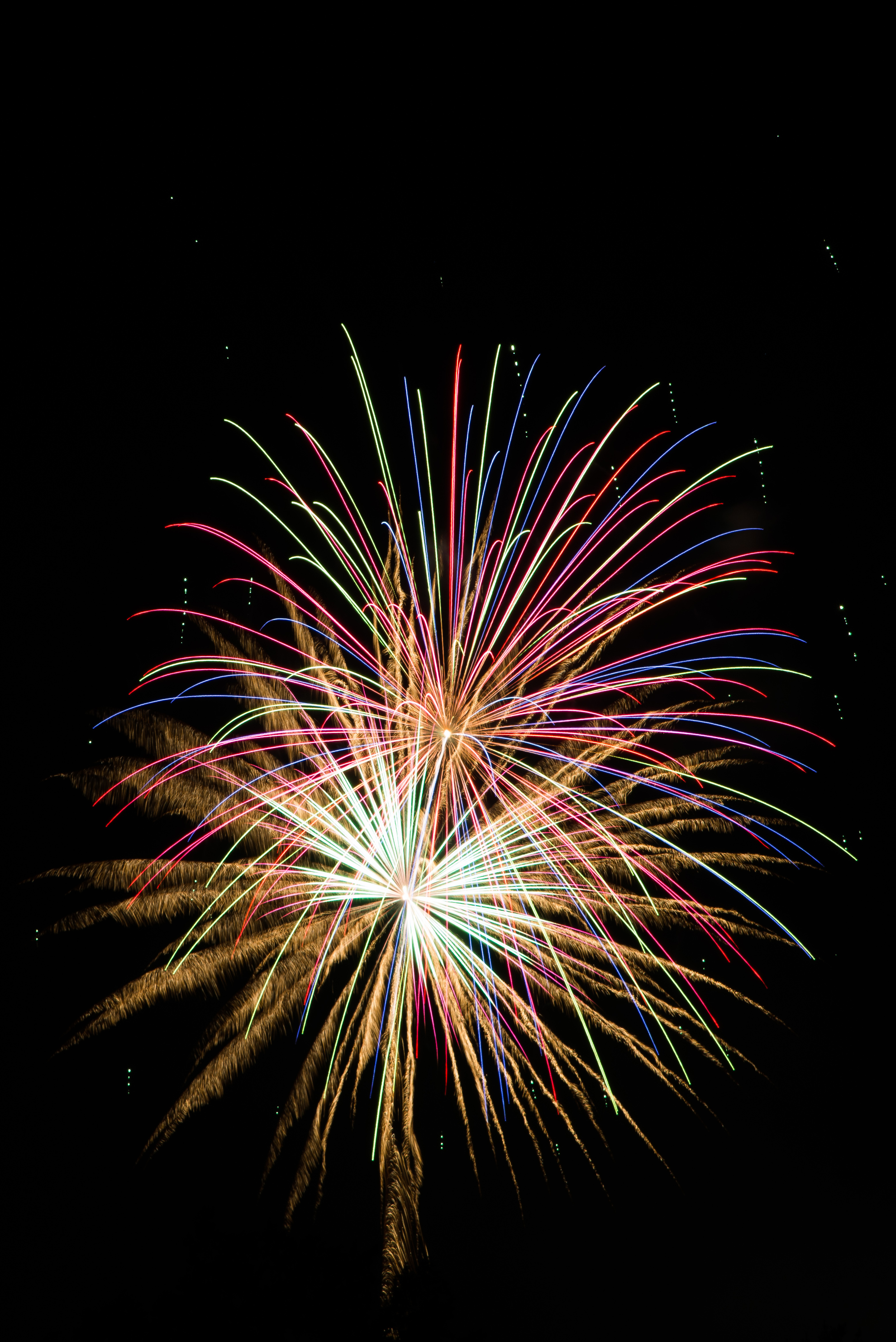
I don’t teach, I have a finite amount of patience (usually measured in milliseconds) and I have the unique ability to only explain things one way, the way I understand them. If someone doesn’t understand something the way I express it, I quickly run out of options. When it comes to taking pictures of fireworks, the internet was boiling over on the photography blogs last week about how to do it correctly. If you want other opinions, there’s plenty out there. Here’s how I did it on Saturday night.
The Fourth of July is my wife’s favorite holiday and we usually spend one of the evenings at her aunt and uncle's home located on the side of a hill in Reading. The reason I mention the hill is because the fireworks display is far enough away so that the aerial show is confined to one location in the sky. If you are seated towards the front of a fireworks display, the performance dominates the entire sky which makes capturing the explosions without an ultra wide lens impossible, also your camera would be shooting almost straight up, so it’s hard to make any adjustments.
A tripod is a necessity, and a remote trigger is helpful. The camera’s shutter will be open for between 3-15 seconds, much longer than any human can hold a camera steady without shaking. This is why there are so many blurry images on Facebook, Twitter, Google plus, etc. of fireworks.
Theoretically, here’s how it works. Since you are taking a picture of a black sky the shutter could stay open in the camera for quite a while as there is little or no light getting in. While the camera is waiting for something to happen in front of it, a firework ascends to the sky and bursts open with marvelous colors streaming through the heavens. Afterwards, you release the shutter, and the camera stops taking a picture. You can leave the shutter open as long as you want, but the longer it's open the noisier things get in the sky. My average was between 4-7 seconds, sometimes quicker during the finale. My camera settings are listed below the image and they never changed throughout the evening, except for shutter speed, which we already covered.
Post processing: In Lightroom make whatever adjustment you would normally when shooting RAW (you do shoot RAW right!) then pay attention to any white clipping. If the highlight warning is lit I use the “whites” slider to correct it. If it’s still clipping I adjust the “highlight” slider down just a fraction until the clipping indicator goes out and then gradually increase the “whites” slider until the warning returns.
One or two tips: Turn off any ISO noise compensation in your camera because you’ll miss pictures waiting for your camera to process images. Better shots happen with less smoke in the air so usually at the beginning of the show. Use the first few explosions to set your focus and then turn off auto focusing. Your depth of field should be fine with apertures 10 and up.
Nikon D800 Tamron 24-70mm f/2.8 @ 70mm f/16 ISO 100 3.6 seconds




Finishing Beach Week
My favorite beach picture doesn’t have a beach in it but, not only is it my favorite beach picture ,it is also one of my all time favorites. We were away for the weekend visiting Ocean City, Maryland ,and I had taken some wonderful sunrise pictures on Saturday morning. Early Sunday I arose to the sound of rain. Crestfallen, but determined, I ventured out. I drove to the Southernmost point of the city where the Atlantic flows into the Ocean City Inlet, where there is a giant parking lot. I sat in my car gazing out at the black sky knowing that a sunrise was out of the question today. Workers were out inspecting the amusement rides and collecting trash from the night before, sweeping the wet sand and puddles from the blacktop. I thought about how chilly the wind was, how biting the drizzling drops would feel against my face, and how violent the surf was. I wished the clouds would part and resurrect this pre-dawn disaster. I waited...
Then I had an idea. I had read about, and seen examples of, long exposure photography. I thought now might be the time to give it a try. Standing on the beach looking out into the pitch black was intimidating. I thought the pier would give a nice focal point for the picture, since it was the only thing I could see, and the lights would give the camera something to focus on. I never imagined the image below would appear in the viewfinder. Because the shutter was open for more than twenty seconds, the moving waves disappeared into a calm pool of water. The lights on the pier shone like stars and the blue in the sky and on the ocean glowed richly on the display. The camera’s sensor, being exposed to the faint light for so long, captured the rich azure blue my eyes were incapable of perceiving. I gaped in awe at the camera. It was a fabulous morning.
Nikon D5100 Nikkor 17-55mm f/2.8 @ 17mm f/13 ISO 100 20 sec
Independence Day!
Here in the US we celebrate our independence from Britain on July 4th annually. The ideals of our forefathers may be lost on today's generation, but hopefully this is not the case. America’s birth was painful and bloody, but a necessary step in the evolution of not only government, but also humanity. Finally after millennia of dictatorships, martial law, and tyrants, a fragile thought burst into existence - that a society could prosper and govern itself using higher standards than the whims of its rulers. A belief that the human race was at last ready to be governed by laws, and a set of principles, written for people “endowed by their Creator with certain unalienable Rights” (Declaration of Independence) was birthed on this day in 1776. So celebrate our Independence Day!